How Pro Athletes Deal With Anxiety

My Take Aways From: How Pro Athletes Deal With Anxiety by Kevin Gray

How Pro Athletes Deal With Anxiety

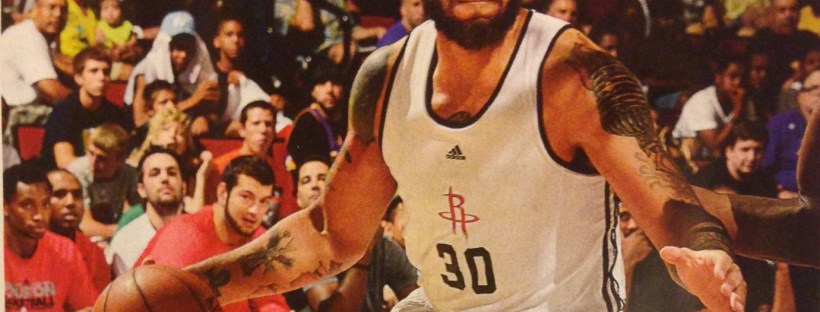
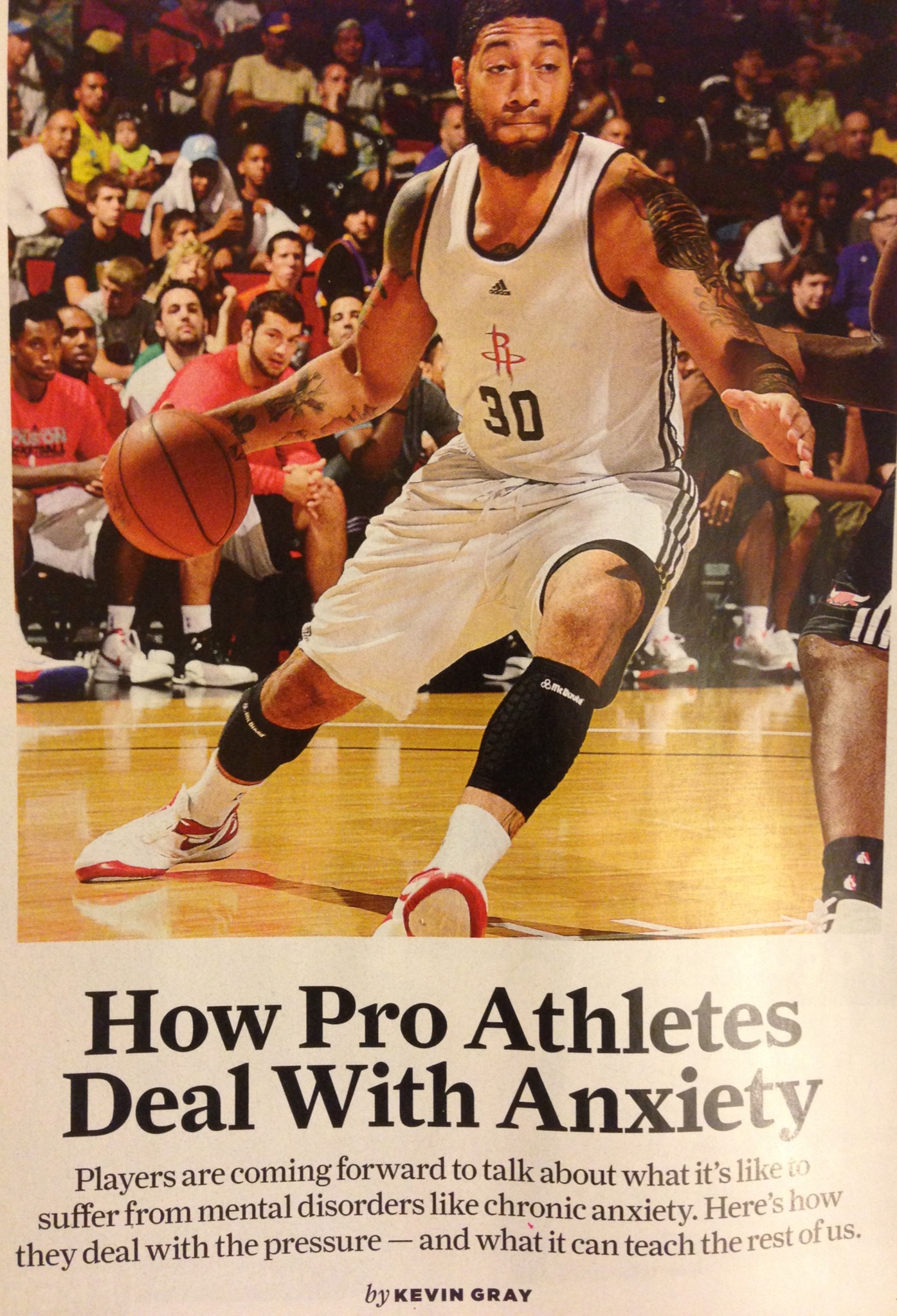
How Pro Athletes Deal With Anxiety by Kevin Gray (Men’s Journal May 2013)

Here are the key points I took away from this article by Kevin Gray:

  • “Nervousness is your friend. It’s a normal reaction to an important moment in your life.” – JoAnn Dahlkoetter Stanford Medical Center Sport Psychologist
  • Anxiety is basically an adrenaline dump, your body’s fight-or-flight response.
  • This natural response goes off the rails when the body gets run down or is already ridden with stress.
  • Hangovers are a known trigger for panic attacks: a heavy night of drinking can lead to fatigue, dehydration, too much caffeine, and not enough food.
  • Stress is the most common trigger.
  • The most effective way to inhibit their internal fears and fend off a panic attach is to breathe.
  • Full blown panic attacks occur when there is an imbalance of oxygen and carbon dioxide
  • Slow deep breathing gets much-needed oxygen to the brain.
  • “Square Breathing” – breathe in deeply on a count of four and then exhale completely on a count of four, repeating three or four times. The key is to exhale all the way because you can’t take in air unless you completely empty out your lungs.
  • Mental visualization also helps: see yourself doing exactly what needs to be done. (ie., the tennis strokes you’ll use, your approach shots, your line game, etc.). But also visualize distractions, upsets, and other scenarios.
  • Anxiousminds.org is a website created by Royce White to educate anxiety sufferers.
3rd Medal

3rd Time is a Charm

3rd Half Marathon

3rd Half Marathon

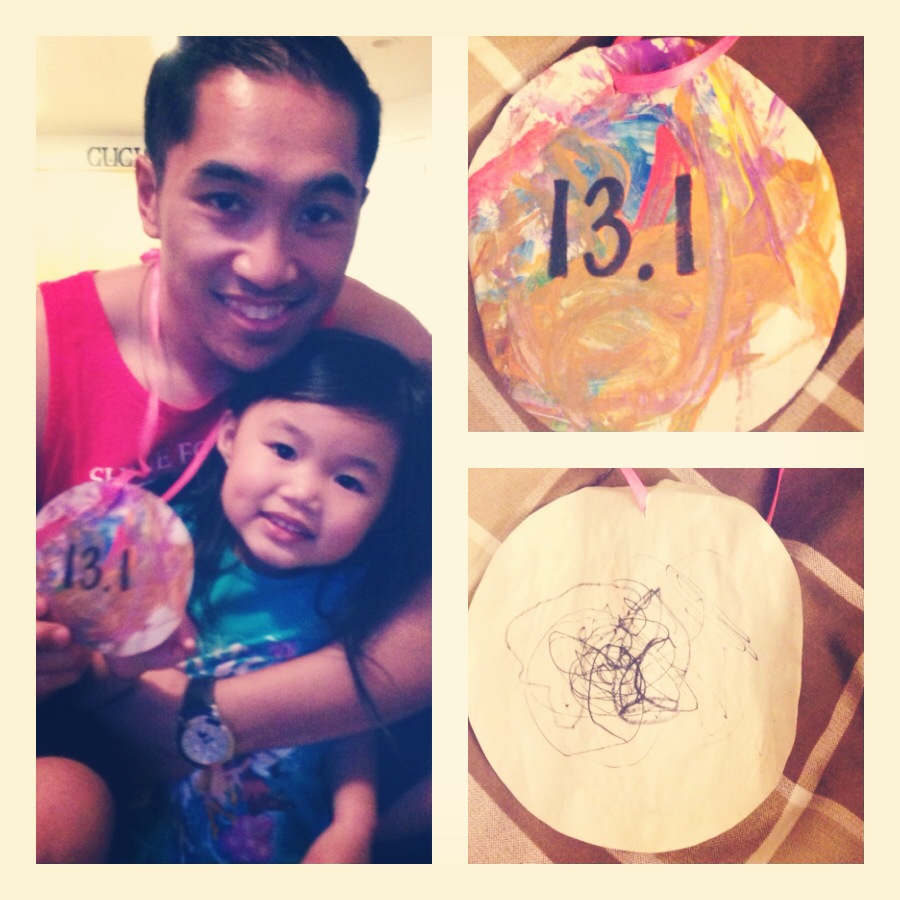
I ran my 3rd Half Marathon on February 17, 2013. Here is my caption from my IG post:

“Third Half Marathon in the books! It was a good run, finished in 1:58. After mile 9 I had to walk a bit, but I sorta made up for it by doing some intervals as much as I could. I hadn’t run this whole week, so now I know that I gotta keep up with my training program if I want to run a 1:45 Half Marathon in the future. My lady also ran Lake Merced and she did it in 40 minutes! Holler! So it was a good day the the Lake. I wasn’t able to run an official race b/c there weren’t any in the Bay Area scheduled for today. So I wasn’t able to get all the free shhtuff given out at those races, BUT I got something better! My niece made a medal for me! This is by far the best medal I’ve ever gotten. She painted the front and wrote me a little something on the back.”

This was definitely one of the best races for me just because of the medal I received for completing it. Never ever forget about why you do what you do in life. My family is my number one and they are the reason I try to live a good and healthy life. My 3rd Half Marathon  was definitely a charm.

Cheers!

Thinking For A Change

Create Something

Thinking For A Change

Thinking For A Change


Skill #3: Discover the Joy of Creative Thinking

  • “The joy is in creating, not maintaining.” – Vince Lombardi (97)
  • “Originality is the art of concealing your source.” – Thomas Edison (98)
  • “To stay ahead, you must have your next idea waiting in the wings.” – Rosabeth Moss Kanter (99)
  • “The most valuable resource you bring to your work and to your firm is your creativity.” – Annette Moser-Wellman (99)
  • “Every child is an artist. The problem is how to remain an artist once he grows up.” – Pablo Picasso (100)
  • Characteristics that creative thinkers have in common: (1) They value ideas, (2) explore options, (3) embrace ambiguity, (4) celebrate the offbeat, (5) connect the unconnected, and (6) don’t fear failure. (101-104)
  • “Highly creative people are dedicated to ideas. They don’t rely on their talent alone; they rely on their discipline. Their imagination is like a second skin. They know how to manipulate it to its fullest.” – Annette Moser-Wellman (101)
  • “Imagination is more important than knowledge.” – Albert Einstein (101)
  • Creative thinking works something like this: THINK > COLLECT > CREATE >CORRECT > CONNECT
  • An essential aspect of creativity is not being afraid to fail. (104)
  • “anxiety is the essential condition of intellectual and artistic creation.”(104)
  • Sometimes creative thinking lies along the lines of invention, where you break new ground. Other times it moves along the lines of innovation, which helps you to do old things in a new way. (105)
  • “You can’t use up creativity. The more you use it, the more you have. Sadly, too often creativity is smothered rather than nurtured. There has to be a climate in which new ways of thinking, perceiving, questioning are encouraged.” – Maya Angelou (107)
  • If you cultivate creativity, you will become more attractive to other people, and they will be drawn to you. (107)
  • “Creativity is the joy of not knowing it all.” Ernie Zelinski (108)
  • Creativity is teachability. It’s seeing more solutions than problems. (108)
  • The status quo and creativity are incompatible. (108)
  • Wrong questions shit down the process of creative thinking. (111)
  • “The uncreative mind can spot wrong answers, but it takes  a creative mind to spot wrong questions. (111)
  • Negative environments kill thousands of great ideas every minute. (112)
  • A creative environment, on the other hand, becomes like a greenhouse where ideas are seeded, sprout up, and flourish. (112)
  • A creative environment: (1) encourages creativity, (2) places a high value on trust among team members and individuality, (3) embraces those who are creative, (4) focuses on innovation, not just invention, (5) places a high value on options, (6) is willing to let people go outside the lines and (7) appreciates the power of a dream. (112-116)
  • “Studies of creativity suggest that the biggest single variable of whether or not employees will be creative is whether they perceive they have permission.” – David Hills (112)
  • Creativity always risks failure. That’s why trust is so important to creative people. (113)
  • “Creativity comes from trust. Trust your instincts. And never hope more than you work.” – Rita Mae Brown (113)
  • Creative people say, “Give me a good idea and I’ll give you a better idea!” (114)
  • Look at more stuff, and think about it harder… That’s the formula all of us can learn to embrace if we want to become more creative people.
Thinking For A Change

Focus, Focus, Focus

Thinking For A Change

Thinking For A Change

Skill #2: Unleash the Potential of Focused Thinking

  • “He did each thing as if he did nothing else.” – Spoken of Novelist Charles Dickens (77)
  • Focused thinking can do several things for you: (1) Harness energy toward a desired goal, (2) give ideas time to develop, (3) brings clarity to the target, and (4) take you to the next level. (80-82)
  • Focus can bring energy and power to almost anything, whether physical or mental. (80)
  • “To be able to concentrate for a considerable time is essential to difficult achievement.” – Bertrand Russell (80-81)
  • A good idea can become a great idea when it is given focus time. (81)
  • “knowledge is power only if a man knows what facts are not to bother about.” – Robert Lynd (81)
  • One of the most important things about golf is the presence of clear goals. (82)
  • “The immature mind hops from one thing to another; the mature mind seeks to follow through.” – Harry A. Overstreet (82)
  • Be selective, not exhaustive, in your focused thinking. For me, that means dedicating in-depth thinking time for four areas: leadership, creativity, communication and intentional networking. (83)
  • Identify Your Priorities (84)
  • “a conclusion is a place where you get tired of thinking.” – Edward DeBono (84)
  • Discover Your Gifts (84)
  • if you’re going to focus your thinking in your areas of strength, you need to know what they are.” (85)
  • Develop Your Dream ((85)
  • “You will become as small as your controlling desire, as great as your dominant aspiration.” – James Allen (85)
  • “The real path to greatness, it turns out, requires simplicity and diligence. It requires clarity, not instant illumination. It demands each of us focus on what is vital — and to eliminate all of the extraneous distractions.” – Jim Collins (86)
  • Wherever you are… be there! (87)
  • The mind will not focus until it has clear objectives. But the purpose of goals is to focus your attention and give you direction, not to identify a final destination. (89)
  • “If you can’t write your idea on the back of my business card, you don’t have a clear idea.” – David Belasco (89)
Thinking For A Change

Always Think “Big Picture”

Thinking For A Change

Thinking For A Change

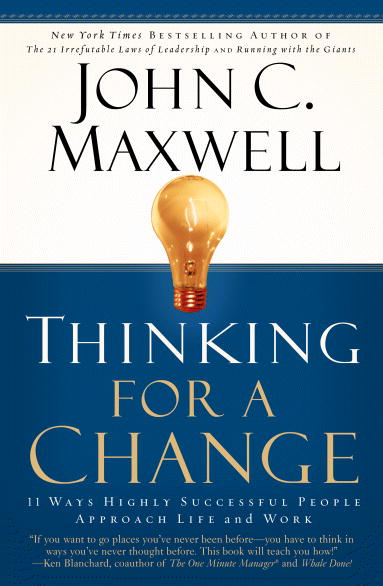
Part I of this book had some really good shtuff in it, but I wasn’t able to make time to write about the key points that stood out to me. I will do a better job for Part II: Eleven Thinking Skills Every Successful Person Needs. I will actually use these types of posts as my “notepad” when I complete the assigned readings for my Leadership & Critical Thinking course. As most of my posts about the books in my “Bookshelf,” I will just report (in bullet form) the more interesting points that I found in each chapter. Hopefully these bullet points serve a purpose for you; whether they be good conversation starters or even serve as “thought provokers.” Definitely, comment on any of these posts with your thoughts and we can have a discussion 🙂 Enjoy!

Skill #1

  • “Where success is concerned, people are not measured in inches, or pounds, or college degrees, or family background; they are measured by the size of their thinking.” – David Schwartz (59)
  • “We all live under the same sky, but we don’t all have the same horizon.” – Konrad Adenauer (61)
  • How many thousands of people had seen what Eratosthenes saw and never made the same connection? (61)
  • When somebody like Jack Welch tells a GE employee that the ongoing relationship with the customer is more important than the sale of an individual product, he’s reminding them of the big picture. (62)
  • Spend time with big-picture thinkers and you’ll find that they: (1) Learn continually, (2) Listen intentionally, (3) Look expansively and (4) Live completely. (63-65)
  • Big-picture thinkers are never satisfied with what they already know…. they often are able to connect the unconnected. They are life-long learners. (63)
  • If I’m going to learn and grow, I must know what questions to ask and know how to apply the answers to my life. (63)
  • Big-picture thinkers recognize that they don’t know lots of things. (64)
  • Big-picture thinkers realize there is a world out there besides their own, and they make an effort to get outside of themselves and see other people’s worlds through their eyes. (64)
  • You can spend your life any way you want, but you can spend it only once. (65)
  • [Big-picture thinkers] experience fewer unwanted surprises, too, because they are more likely to see the many components involved in any given situation: issues, people, relationships, timing and values. They are also, therefore, usually more tolerant of other people and their thinking. (65)
  • Leaders must: (1) See the vision before their people do, (2) Size up situations, taking into account many variables, (3) Sketch a picture of where the team is going, (4) Show how the future connects with the past to make the journey more meaningful, and (5) Seize the moment when the timing is right. (66-67)
  • “He that is everywhere is nowhere.” – Thomas Fuller (67)
  • “You’ve got to think about the ‘big things’ while you’re doing the small things, so that all the small things go in the right direction.” – Alvin Toffler (67)
  • One of the most important skills you can develop in human relations is the ability to see things from the other person’s point of view. (68)
  • see what other see… that is a powerful thing. (68)
  • The better the grasp team members have of the big picture, the greater their potential to work together as a team. (68)
  • The person who forgets the ultimate is a slave to the immediate. (69)
  • With preparation, the most important things will be done well. (69)
  • If you want to cultivate the ability to think big picture, then you must get used to embracing and dealing with complex and diverse ideas. (71)
  • Learn from Every Experience: Failing Forward (71)
  • Teachability is an attitude, a mind-set that says, “No matter how much I know (or think I know), I can learn from this situation.” That kind of thinking can help you turn adversity into advantage. It can make you a winner even during the most difficult circumstances.” (71)
  • If you want to be a big-picture thinker, you will have to go against the flow of the world. (73)
Triple Crown 10K

Triple Crown 10K

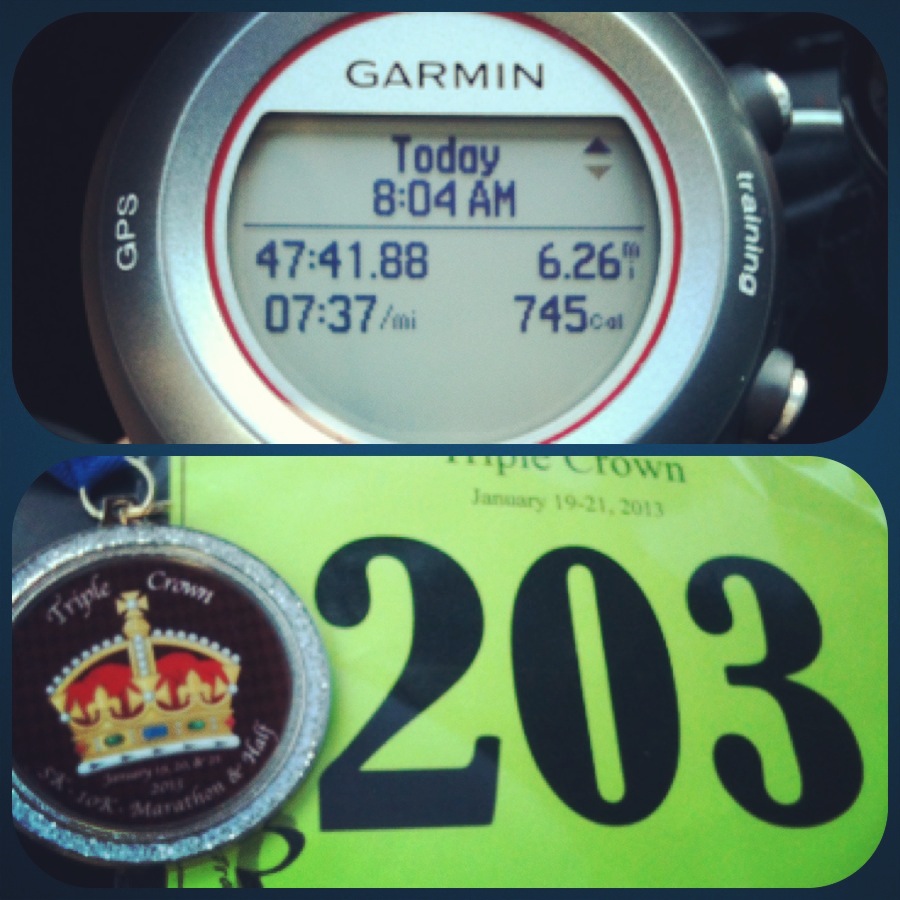
You know the routine: after a race, I eat food and drink water and post a picture with a long caption on my IG account. So here’s what I posted on my IG after my 10K today:

Triple Crown 10K

Triple Crown 10K

“4th 10K in the books. This was a very familiar run because I’ve run Lake Merced plenty of times before. The only difference was the direction we ran for this 10K; I usually run counterclockwise, but this race was run clockwise. I placed 1st in my age group and 1st overall in the 10K field!!! Woooo!!! In yo face Usain Bolt!!!  Yea, the field was 4 deep and I was the only male and the youngest female of the group was 46, but hey, shut your mouth :). Now it’s time for a fresh cut before I see the gang. Happy Sunday everyone!

I was really happy with my overall time. Ever since I got this Garmin, I’ve been pushing myself a little harder. This was a faster pace than my 8-miler last week on the same course. I have a crazy week ahead of me, so I hope I can make time to do my runs and get some good rest; we’ll see how that goes. I hope you’re all doing well! Go 9ers!!! Cheers!!

8 miles - Lake Merced

“Long Run” Sunday

8 miles - Lake Merced

8 miles – Lake Merced

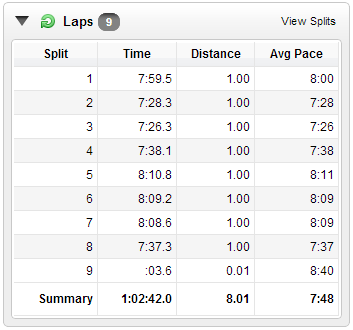
This was by far the best Lake Merced Run that I’ve ever had. I’ve run 10 miles around Lake Merced before, but this 8-mile run was fast (to my standards) and I felt so damn good after; I wasn’t too tired, I wasn’t breathing hard, nothing was aching, and I just felt gooooood.

And this is the first time that I used the my Garmin to challenge myself. And what I mean by that is, I set my Garmin to a 8:00 minute pace, whereas in the past I wouldn’t set a desired pace and just used the watch to track my current pace, overall distance and overall time. And to be honest, at the start of my run, I wasn’t sure if I would be able to keep up with that pace, but as I mile 2 came along I was feeling good. And after mile 3, I felt the same. By mile 4 I was in the zone! My strides felt good, my breathing felt good and I just felt goooooood. I’m glad that I used that desired pace function because I think it pushed me and challenged me and it showed me that I can absolutely run an 8:00 minute mile (over 8 miles at least). And to be honest, I think I could have gone another mile or 2 at that 8:00-minute (or faster) pace.

This watch is definitely one of the best Christmas gifts I’ve ever received and I’ve thanked my girlfriend every day since I received it.

Well, that was my “Long Run” Sunday. I’m not gonna lie, I don’t think I’ll post my whole week recap anymore. I’ll keep my running updates short and simple like this post. I hope you all have a great week! Cheers!

Uhhh, What New Year’s Resolution?

Ok, I know I said I would post something every day this year, but this whole Grad School thing is getting in the way, lol.

I’m just kidding, I’m loving this first week of Graduate School! It’s just a whole lot of work. Between working full time at the Y, keeping up with my running schedule (I ran 8 miles today btw), and completing all the reading and writing assignments for my Sport Management Program, I have not MADE time to post something every day. I say MADE time because I know I have time to write a little something every day, I just haven’t gotten used to this new schedule. Once I get a hold of my schedule, I intend to get back to posting something every day. I hope all of you are running and staying healthy! Know that I am doing the same, even though my work and school schedule is chaotic right now. Take care! Cheers!

Sports Management Handbook

Grad School Starts……. Now

Sports Management Handbook

Sports Management Handbook

So today was Orientation for my Sports Management Program at USF! I’m super excited to start this new chapter in my life and I can’t wait to see where this takes me.

The Orientation went well and I was able to meet a lot of my Cohort. My Cohort (Cohort 38! Woot Woot!) seemed like a really cool bunch and I really think we’re all going to get along and have lots of fun. We all have different backgrounds and experiences that I know will make us a strong and well-rounded Cohort.

There were a few Alumni (and current students) of the program that came to speak and they give us a little insight on what the program did (or is doing) for them and their careers in the Sports Industry. The Alumni were great representatives of the program and they got me even more excited about all the opportunities that will be presented to me, and my Cohort, in the coming months.

Our first class starts tomorrow night and I’m super excited to get started! Grad School, lehhhh goooo!!! Cheers!!!