
Category: Uncategorized
4 Steps to Getting Out of a Rut
If you are on Instagram, follow me: @ypowr & @cool_fit_dad
Thanks for watching everyone!!! Comment below and let me know your thoughts on this video!!
Thoughts on Calls to Action?
We typically see someone or some organization create a Call to Action because they want the help of their supporters or customers in creating some type of CHANGE.
For those of us who are in positions to initiate Calls to Action (hint: that’s all of us), here are a few things to keep in mind:
1. CHANGE unfolds through a series of stages, with ACTION being just one stage.
2. The ACTION stage is not the only time you can make progress.
3. ACTION is the most visible form of change, but far from the only one and not necessarily the most important one.
4. Before the ACTION stage, there are a few other stages (Pre-contemplation, Contemplation and Preparation) where people change their level of awareness, their emotions, their self-image, their thinking, etc. And these stages are important because this is when they are changing to more POSITIVE emotions and a more POSITIVE self-image and more POSITIVE thinking… well hopefully their all POSITIVE changes. Because if their experiences during these earlier stages are negative, then their actions will be negative. So you can see how a Call to Action, even one with good intention, can move people to act even though they are not prepared (on many levels) to act.
— and a quick note on how I differentiate POSITIVE actions from NEGATIVE actions: positive actions focus on solutions, strengths and the future and they come from a place of hope. Negative actions focus on the problem, weaknesses and the past and they are rooted in fear.
So yes, we want ACTION. But don’t we want POSITIVE action? And more importantly, don’t we want those positive actions be long lasting?
So all I’m trying to say is: let’s continue with our Calls to Action, but let’s make sure we are spending just as much time, energy, thought and other resources on the steps that lead to POSITIVE, LONG LASTING action.
Thoughts? And thanks for reading!
Changing for Good: Chapter 1 Highlights
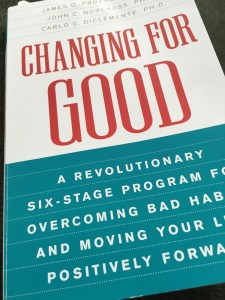
My key highlights from Chapter 1:
- Coaches need to be prepared to meet their client’s where they are at and be comfortable with allowing them to drive the conversation. “Think of the range of possibilities you confront when you combine an individual client, with one or more complicated problems, with a [coach] schooled in a particular theory.”
- Rather than shaping the therapy to the needs of the client, most therapists assume that the client’s issues will fit into a particular mold.
- All the hundreds of theories of therapy can be summarized by a few essential principles I [Prochaska] call the “processes of change.”
- Process of Change = any activity that you initiate to help modify your thinking, feeling, or behavior.
- The 9 Processes of Change are:
- Consciousness raising
- Social liberation
- Emotional arousal
- Self-reevaluation
- Commitment
- Countering
- Environment control
- Rewards
- Helping relationships
- for each process, there are dozens, even hundreds of techniques
- people are more likely to be successful in their change attempts when they are given two choices of how to pursue change rather than once
You Are What You THANK About
You Are What You THANK About
We’ve all heard the saying “you are what you think about all the time,” but I think an even truer and an even more important saying is “you are what you THANK about all the time.
Nothing changes your life faster than shifting your thoughts to the things and the people you are grateful for. When our thoughts are in a good place, then our feelings are in a good place. And these feelings act as a compass for our actions. These feelings tell us which direction we are facing and in turn, let us know whether we should speed up, slow down, or stop for a second.
I’ve learned that what we think about, we bring about. So why would we think about anything else other than the good and positive blessings in our life? Every second, we realize our thoughts and they become our reality.
So think good. Think about love and everything that you are THANKFUL for.
(8-minute writing exercise #1)
Changing for Good: Introduction Highlights
My key highlights from the Introduction:
- change is unavoidable
- each moment is different from every other. nothing remains static for an instant, from a planetary to a molecular level
- the action stage is simply one of six stages — following precontemplation, contemplation, and preparation, and preceding maintenance and termination
- fewer than 20% of a problem population are prepared for action at any given time. and yet, more than 90% of behavior change programs are designed with this 20% in mind
- [successful] self-change requires that you know what stage you are in for the problem you want to overcome
- even people who are not ready to act can set the change process in motion
- 45% of clients drop out of psychotherapy prematurely, since treatments too often don’t match the stage clients are in
- there are fewer differences between therapy-changers and self-changers
- it can be argued that all change is self-change, and that therapy is simply professionally coached self-change
- the key is always to use the right strategy at the right time
- very often, failure is due to lack of guidance — most self-changers are so busy reinventing the wheel that they become exhausted during the course of their struggle
#ypowr shirts
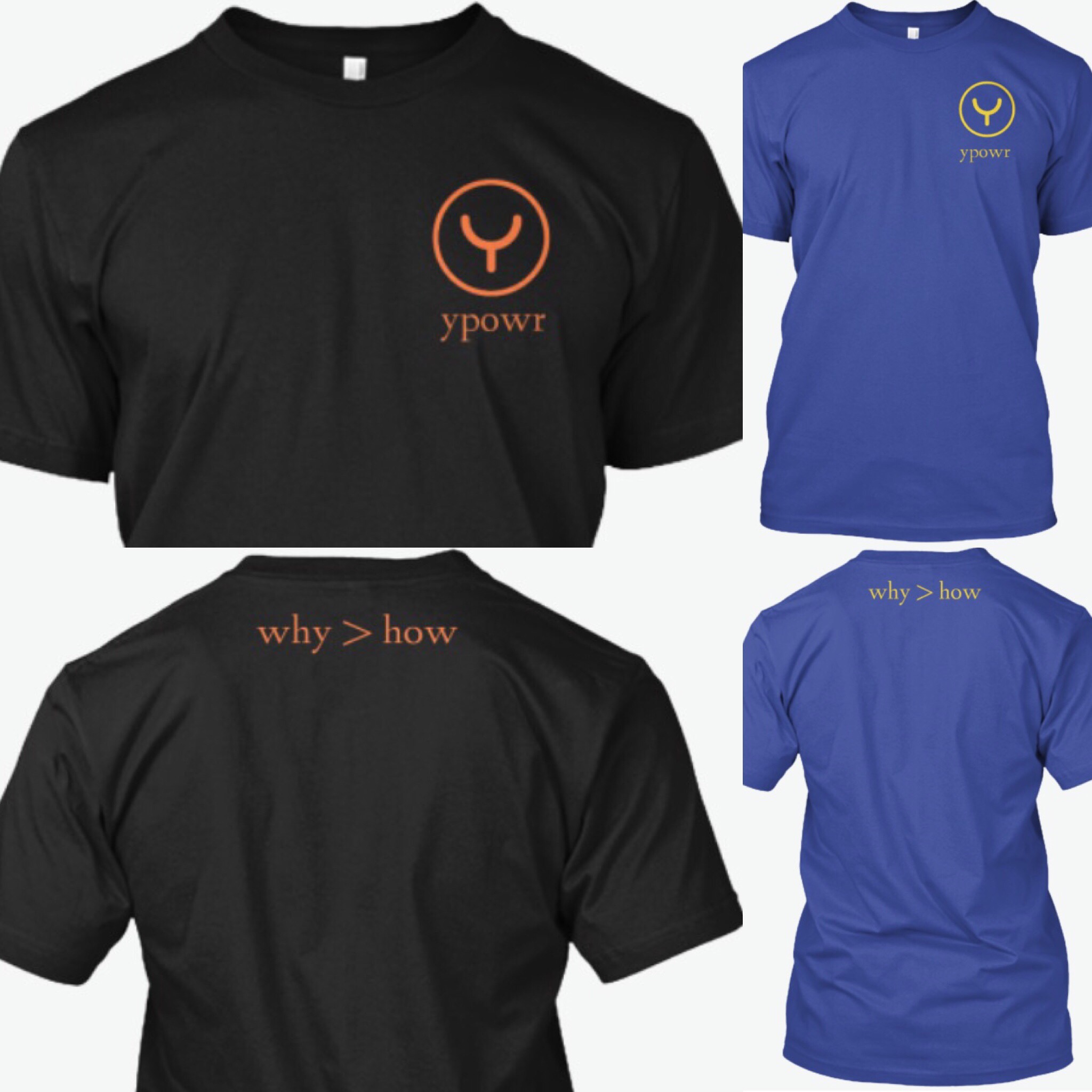
Hey everyone! Check out my campaign on Teespring for my first ever #ypowr shirts!
⠀⠀ ⠀
As some of you may know, I’ve been working on ypowr for a little over 4 years now. Some of you might be wondering what ypowr is? Well, ypowr is the power of your purpose. ypowr as a brand is all about positivity, growth, motivation, support, good vibes, health + fitness + wellness, celebration, prayer, laughter, reflection, and all that good stuff.
⠀⠀ ⠀
ypowr is a reminder that you have a purpose and that the power of your purpose is strong enough to get you through anything and everything this life has to offer. So what is your purpose in this world? What is your why? Whatever it is, let this shirt be your daily reminder.
⠀⠀ ⠀
Supporting ypowr means recognizing, supporting and encouraging anything and everything that good in this world.
⠀⠀ ⠀
Thanks in advance for your support!
3rd Time’s a Charm
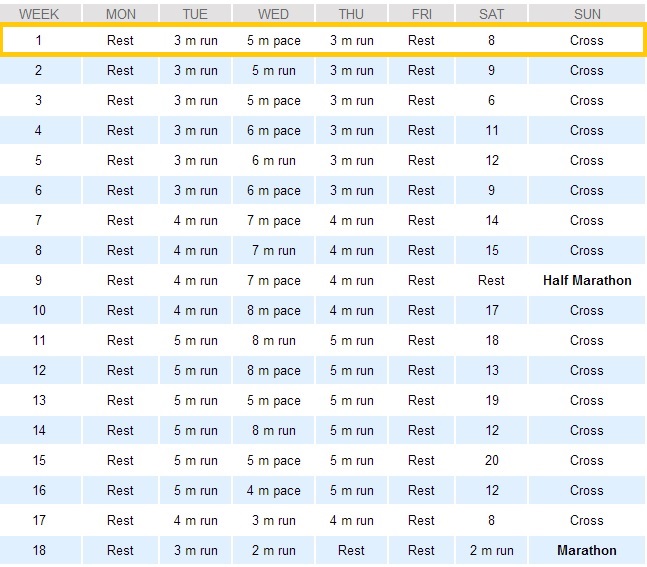
FMT 3: Week 1
“There are two types of pain in this world: the pain of preparation and the pain of regret.” – Dr. Cellini
I now have two marathons under my belt and I am extremely grateful and blessed to have been healthy enough to complete them both. If you told me two years ago that I would have completed two marathons before my 29th birthday, I would have thought you were crazy.
There comes a point during a 26.2 mile run that your brain tries its best to make you quit. It tells you that you won’t finish, it tells you to stop at the next water station, it calls you stupid for not training as hard as you should have, it tells you that you don’t need to be running right now, that you could be at home sleeping instead. There comes a point during a 26.2 run that giving up seems to be the best and only option. During my first marathon, that point came at about mile 17. For my second marathon, that point came a lot earlier around mile 13.
When I think about my first two marathons, I can’t help but hear Dr. Cellini’s words “… the pain of preparation and THE PAIN OF REGRET.” By no means am I saying that I regret running these marathons. I have become a better person because of these marathons. What I am saying though is that I regret not training to the best of my ability; I regret not preparing.
My training always starts off well, but then I fall off. I have so may reasons (excuses) why this happens and quite frankly, I’m tired of thinking about these reasons (excuses). I am determined to stick to my training program for my third marathon. All I have to do now is, “GET IT DONE”

Discipline > Motivation
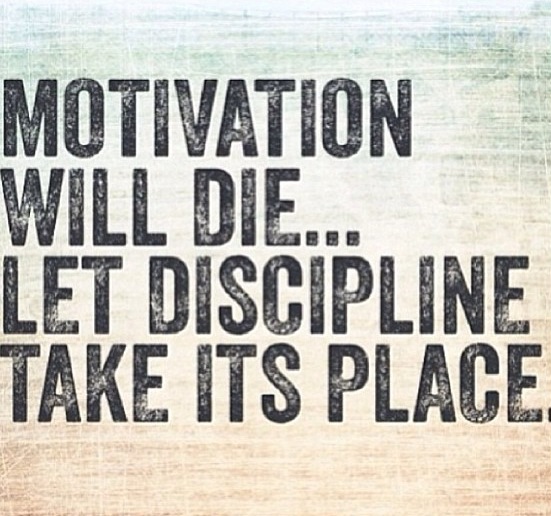
Discipline > Motivation
Motivation is what gets you started. Discipline is what keeps you going. Continue to build those good, positive, and healthy habits every single day. We GET to work today, let’s go.

My Take Aways From: How Pro Athletes Deal With Anxiety by Kevin Gray

How Pro Athletes Deal With Anxiety by Kevin Gray (Men’s Journal May 2013)
Here are the key points I took away from this article by Kevin Gray:
- “Nervousness is your friend. It’s a normal reaction to an important moment in your life.” – JoAnn Dahlkoetter Stanford Medical Center Sport Psychologist
- Anxiety is basically an adrenaline dump, your body’s fight-or-flight response.
- This natural response goes off the rails when the body gets run down or is already ridden with stress.
- Hangovers are a known trigger for panic attacks: a heavy night of drinking can lead to fatigue, dehydration, too much caffeine, and not enough food.
- Stress is the most common trigger.
- The most effective way to inhibit their internal fears and fend off a panic attach is to breathe.
- Full blown panic attacks occur when there is an imbalance of oxygen and carbon dioxide
- Slow deep breathing gets much-needed oxygen to the brain.
- “Square Breathing” – breathe in deeply on a count of four and then exhale completely on a count of four, repeating three or four times. The key is to exhale all the way because you can’t take in air unless you completely empty out your lungs.
- Mental visualization also helps: see yourself doing exactly what needs to be done. (ie., the tennis strokes you’ll use, your approach shots, your line game, etc.). But also visualize distractions, upsets, and other scenarios.
- Anxiousminds.org is a website created by Royce White to educate anxiety sufferers.
 ypowr
ypowr 